Showing posts with label Garlic. Show all posts

Sunday, July 31, 2011

Harvest Begins

Gathered enough green beans today (and a tiny purple one that I couldn't resist) to actually have enough to eat as a side dish today.  There are still 30 or more tiny, tiny ones that will hopefully be ready to eat next weekend when I return home.
The harvest actually started in June with the first of the garlic.  This place is from last week - the last of the small garlics to be cured and the first little beans to be picked.
I just love the colors and textures of the hard necked garlics.  It was a cool, wet Spring, and many of the garlics did not bulb up as much as I expected.  Still, my house smells either delightful - or stinky - right now, depending how much one loves the stinky rose.
Herbs that were chopped fine and added to my home grown eggs this morning: a sage leaf, a touch of oregano, and some tender new growth from my rosemary. 
I worried about taking my eye off the zukes for 5 seconds to go on business travel.  While I did not find any that were baseball bat sized, I did find one that was as long and as thick around as my fore arm!  Won't have time to do anything with it, and there are 5 young ones on the vine right now, so I think I will slice it length-wise and let the chickies devour it tomorrow.

Sunday, July 24, 2011

Random Photo Day

Some early morning photos from this morning.  Nothing fancy or revolutionary - just a nice  little walk around the garden before the blazing sun warms everything up.  The rule of thumb is, 60*F by 6 am, 70*F by 7 am, 80*F by 8 am, and 90*F by noon.  Remember, you can click on the photo for a larger version.
Just a few years ago this apple tree was a mere stick, barely bigger in diameter than my thumb.  It now sports a trunk bigger around than my wrist.  Fickle Desert Spring froze all the buds this year, so no apples.  Still, it is nice and green - and I harvest the suckers (some call them water sprouts) for the ducks and chickens to dine on.
 This is a purple bush bean called Velour.  The flowers and stems are purple, and some of the leaves have purple flecks in them.  The tiny beans (the one in the photo is about an inch long) turn purple as they mature, and turn deep green when blanched or cooked.  The plants are not as vigorous as say, Kentucky Wonder; however, they are cute, and the purple beans are easy to find among the green foliage.
 Early morning view of sweet corn in the foreground, the root stock of a peach tree (redish leaves), all overlooking sunlit weeds in the distance.  Fill flash was a little too heavy, giving it a very contrasty, almost artificial look compared to what I saw - but it still picked up the glow of the weeds, and that was one of my main objectives.
 Detail of a garlic scape.  I let about 50 of these form bubils.  Not sure that they will make new garlic plants, and even if they do, it could take 5 years before they are big enough to harvest.  Chickens really do eat anything, however, so I have been giving some to them.  Garlic is supposed to act as a natural de-wormer.  I don't think they have worms, but I'm feeding them the bubils just in case.  Besides, they love chasing down the little balls of garlic when I throw them in their pen.
 Nodding garlic scapes with their hundreds of tiny bubils.  The early morning golden light really brings out the pink colors in them.  During the flat light of the day, they look more brown.
 My girl on patrol.  Her web is in bed one and is strung between Sweet Marjoram, Rosemary, and Lemon Balm (although I like it's official name better: Melissa Officinalis.).  I know she is a girl because most male spiders have hooks on their front legs to hold the female with during mating.  She has been hanging out for a few weeks, now.  Eat and be merry, Garden Friend!
More weeds and morning sunshine.  This time the weeds are inside the garden.  I left them there because I want them to spread their 900,000,000,000 seeds all over my garden.  Actually, I left them up because the ducks rest on the other side of the fence in the shade of these weeds in the late afternoon.  Makes a decent wind break for them.

Saturday, July 16, 2011

Lazy Day Tour of the Summer Garden

Well, after a week of bronchitis, strep throat, doctor's visits, chest x-rays, antibiotics and asthma inhalers, I am feeling mostly alive again.  Of course, the chipmunks and birds took advantage of my inattention to the garden and have mowed down the last of the late sunflower seedlings.  At least one chipmunk made an attempt at young squash plants, too, but was foiled by the floating row cover.  Still, it left its calling card.
Chipmunk Poop on Floating Row Cover
The first sunflower is in full bloom now, obediently facing the sunrise, no longer tracking the sun in its daily arc over the sky.  Only 2 foot tall with a 6 inch bloom, I believe this is on of the dwarf sunflowers called Sunspot.
The first set of corn is doing well, enjoying their heavily amended and composted bed.  They are heavy feeders, and at the end of last year, I put two wheel-barrels full of semi-composted chickie-poo and pine shavings in that bed to decompose and mellow over the winter.  This seems to have worked well as the corn is flourishing and putting out suckers.  I will trim the weaker suckers and feed them to the chickens; however, the more vigorous suckers may also fruit.  We'll see.  It's one giant experiment.  

The second planting of corn did not have the autumn prep that the first set did, so I have tried to compensate by adding finished compost and growing bush beans with them.  They are growing an inch a week, so I think they are happy.

The garlic harvest is just about complete.  Yesterday I cleaned 7.4 pounds of good garlic and 3.2 pounds of garlic that has one issue or another that will necessitate its consumption within the next two months.  Stored cool, dark, and with ventilation, the better garlic should keep 6 months.  Frozen, it will last a year.  I'm going to make some garlic and olive oil paste and freeze it.  Although it may lose some of its potency that way, it will also be edible for about forever.

Garlic that has been allowed to go to "seed."  The "flowers" are really tiny garlic bulbs.
First of the bush beans are starting to produce.  It will be a few days, still, before they are big enough to harvest.  I planted purple podded beans as my main crop this year, just because I like the color purple.  And because I wanted to add as much color to the desert as I could.  Especially since the critters ate up all the flowers that I planted.
Hopefully I am back to work on Monday, and able to hack down weeds sooner than that.  The beds in the garden are mostly weed-free; however, the paths and edges have the desert denezines creeping in: cheat grass, tumbleweed and some type of eucalyptus plant.

Monday, July 11, 2011

Late Start In the Garden

Due to the last killing frost and last snow being at the beginning of June, it took a while for the garden to get into full swing this year.  This means that getting a corn, pumpkin or winter squash crop will be a gamble this year.  But heck, growing a garden of any sort here in the high desert is a gamble.

Either a Zuke or a Yellow Squash - of course, I am not organized enough to label them.  Good thing I like surprises.

Veggies currently in the ground:
  • Black Beauty Zucchini
  • Yellow Crook Neck Squash
  • Yellow Straight Neck Squash
  • Acorn (Winter) Squash
  • A small, short season (90 day) pumpkin that I can't recall the name of
  • 3 sad Alaskan Fancy determinate tomato plants
  • 40 stalks of Golden Bantam Cross (F1) Corn
  • Sweet Dumpling (Winter) Squash
  • Lemon Cukes
  • Market More 76 Cukes
  • 6 sad little Okra plants that don't like our cold nights (still in the 50*F at night)
  • A few garlic that really should be pulled by now
  • Blue bush green beans (turn green when cooked - or when the temps top 100) - French Velour and True Blue
  • Yellow "Pencil Pod" wax bush beans
  • Dow Gawk "Yard Long" pole beans
  • Kentucky Wonder pole beans
  • Blackeye Peas - both purple hull and California No. 5
  • Last of the snap pea vines (to be fed to the chickens and ducks this weekend)

Bush beans are beginning to bloom, so probably two weeks before we start eating them.  I'm not sure how blue the blue beans will be - the flowers are decidedly purple.   Planting more bush beans every week as they ripen their crop over a short time period (as opposed to pole beans that will bear until frost kills them).  Also, beans will fix nitrogen into my sand.  Since they are cheap seeds to buy, I am using beans like a cover crop.

Speaking of cover crops, I found some old clover seed, and it is making a fair stand under the apple trees.

As for veggies, the rest of them will probably start being ready for harvest whenever I'm on  my next business trip. It's just the way of the world.  A new sprinkler and battery-operated timer setup should at least help insure that the plants will live.  

Saturday, July 9, 2011

Summer Garlic

Summer, to me, doesn't really start until the harvesting of the garlic. I think our heat contributes to their early maturity, and while most people may be harvesting their garlic in July and August, mine are usually ready by the end of June. Being sporadic with the watering may also encourage them to ripen earlier. I planted about 150 good sized cloves and about 200 smaller cloves. There was, of course, chipmunk depredations, a little bit of winter-kill, and some were so small that I have chosen to let them mature bulbils on scapes instead of trying to force them to grow big bulbs. One could certainly tell the difference in the quality of the ground (I don't think I would call it "soil" still yet). The sand amended with chickie-poo/chickie-bedding created compost had overall healthier and bigger bulbs - even from cloves that were not top sized.
1/3 garlic harvest curing.
Average size, about 2 1/2" diameter.

Garlic Scapes producing
bulbils for tiny new garlic plants.
Close-up of a scape and
its bulbils.

Summer is also when all the critters come out to hunt.  Taken too close with my phone camera, so it is somewhat out of focus, but this dragon fly spent some time chasing gnats and then alighted on an old sunflower stalk from last year.

Thursday, June 30, 2011

Spring Arrived for a Day, and now It is Summer

One day it was 70*F or so, and we all thought, "how nice." The next day it was 90*F.  And since then, for at least three weeks now, it has been pleasantly warm in the high eighties and low nineties.  Looks like a cool summer again this year - maybe only a few days in the triple digits?  If so, the garden will love it!
Two week old corn is two to three inches high.  What survived initial bird depredation (in spite of using a row cover), is now healthy and growing rapidly.  Planted out the second set this past weekend.  I may set out some more next weekend, but the beginning of July means that there is a 50-50 chance of a hard frost in September followed by several frost free weeks.  Still, if the third planting just turns out to be a place for the chickens to play, that works ok for me, too.

Ate a few peas yesterday.  Chickens like the shells, but the ducks thought I was throwing rocks or something, as they were not enthused about green things flying over the fence.  The chickens were all to happy to go into "shark attack" mode, however, and swarmed the pea shells.  Sorry, duckies.

Been feeding the ducks and chickens tufts of grass that still have the seeds in them.  The ducks like to thresh the seeds out with their bills while the chickens like to "scratch and attack" the grass stems until the seeds fall out and can be eaten.    The benefits to the birds are that they get some fresh food and exercise.  The benefit to me is grass weed reduction.  The benefit to the grass clump is that they get a trim and extra water and get to grow more seeds.
Egg production is in full swing.  Out of 15 hens, I am still getting 6-8 eggs a day.  In some ways, it is better than the 10-12 eggs a day that they laid in their prime. Still, it is almost like zucchini - be careful - if you stand still, I will hand you eggs!

I hate to jinx myself, but there may be a chance that I have morning glories this year.  I need to plant more.  I am babying along the 6 or 7 that I currently have.  They are getting one new little leaf every few days.  Hopefully they will hit critical mass soon and start climbing several inches a day.

Also looks like I will have more than two dozen sunflowers this year.  I planted a dozen or so more on Sunday, but it's getting late for planting sunflowers, too.  I have a set of volunteers from bird seed - we'll see how they do.
I am letting the garlic that is too small to bulb go to "seed," so to speak.  Their scapes will "flower" with tiny bulbils - each a tiny, tiny garlic.  If I time things right, I can plant out hundreds, which in a few years, will be almost big enough to use as planting stock.... or, I might just eat them.  I planted hot garlic, however, so they will definitely add a fiery zing to whatever I put them in.  Maybe put them in pasta sauce to mellow.

If you build it, they will come.

Sunday, May 15, 2011

Springtime Ramblings

It's amazing what one can do on their phone these days.  This photo was taken and edited on my phone.  I suppose I can also blog via my phone, but haven't spent the time figuring it out because - I have been spending every spare moment in the garden! As you can see, the garlic planted last fall is doing well.
And, I have finally found the solution to the birds and other critters eating my sunflower and other seedlings - row covers.  Duh.  I bought about $30 worth of them this spring, and in stead of losing half (or more) of my seedlings to the voracious wildlings, out of 50 sunflower seedlings, I've only lost 5 (ok, I stepped on two additional ones, but that is a separate issue!).  In this photo is the first bush bean planting - all under wraps.
Rows are about 5 ft long.  Top set includes 4 rows, right to left, one row each of: Ferry Morse "Royal Burgundy" Purple Bean (Ferry Morse Seeds from Home Harvest Seeds) (2011 seed), Pinetree Garden "Pencil Pod Yellow (wax) Bush Bean" (Pinetree Gardens) (2008 seed), Park Seed "True Blue" Green Bean (Park Seed) (2011 seed) and Park Seed "Velour" Purple Bean (2011 seed).  The row on the bottom left has a mixture of them - just figured it would look nice.  I dropped a bunch of the pencil pod yellow wax bean seeds in a puddle, though, so there is a higher percent of them than I originally planned.  The row on the bottom left has radishes.  It's a little early for both beans and  blackeye peas, but I couldn't help but plant a 15 ft double row of Ferry Morse "California Blackeye."  Also planted them under row covers.
A note about the row covers in this photo - right now they are plastered to the sand because I have just heavily watered in the seeds.  They do "float" when they are dry.

Monday, September 27, 2010

Random Autumn Flashbacks From My Garden Journal

No, not from my garden - I took this picture in the Tennessee Smoky Mountains. The edge of the field was filled with two dozen or so of these butterflies flitting from place to place. They did not sit still long, being much preoccupied with eating! Out of 100 photos taken over the course of an hour, I think I got 4 that are pretty good. This is probably the best photo I've ever taken.

Some old journal entries - in order by day of the month. My current comments in [brackets]. Spelling is as written in my journal - no spell check when writing with a pen!

2007-09-30 7:03 a.m. Well, I guess one cannot argue with 25*F - That is a killing frost with no ambiguity. The sun is up - I am not looking forward to seeing the damage.

On the up side, this will mean that I can procrastinate no further on ripping out marginal items and planting out garlic.

Soaked peas last night - 150 are ready to go. I guess I shall find out if they can germinate this cold. [No, they didn't]

Trees have been full of rich, green leaves - will the frost signal them to change color? So far, just a very few yellow leaves on the apple tree and only 2 orange ones on the nectarine.

Days will hopefully warm up. no wind, but cold right now. I should go do something useful in the garden or yard.

2006-10-01 Bought a wireless indoor/outdoor thermometer last week - need to set it up and start checking highs and lows [presumably to help predict frost].

Funny how much you can get done when you are motivated - D. got a job offer for a job in Iraq, so this weekend we got
  • 5 posts for enclosing my garden up
  • concreted the edges of the dogs' pen (one more side to go, but I can do that side)
Things to do
  • Move the 1/2 barrels to the garden area and use for garlic - make drainage holes [There's a notation that this did not get done.]
  • Plant plant gifts from James W. of Dave's Garden [www.DavesGarden.com]
  • Top dress bulbs with low nitrogen fert. (bonemeal)
  • Look at the weather report (definately fall, but no hard frosts yet)

2005-10-05 The sweet gums [trees] are looking decidedly perky this morning. I was concerned that yesterday's dry winds would have been hard on them, but I guess the cooler temps and deep watering helped them. Of course, I took pictures yesterday. Need to add them to my [photo] database. 2006-10-05
  • Watered back yard & fruit trees
  • Watered most east sweet gum [presumably the sweet gum tree to the East of the group]
  • Watered front poplars (south)
  • Irises from Dave's Garden arrived today - about 20 lbs worth
  • 1300 bulbs to go into the ground
All this and David leaves for South Carolina in less than two weeks and then on to Iraq 4 weeks or so later. So much to do. So little time left to be together. A year apart - with the chance of it being permanent. So I plant and plant and grow babies to fill the emptiness.

2007-10-06 21:00 ish After a good nap...This year was the first year in a long, long time that I had a real garden. I am totally so very blessed. To be able to come home from work and eat a few cherry toms from the garden, water the trees, take photos of a sunflower, spy on a lizard. What a joy. To have hopes and dreams. To feel, smell, taste the cycle of life. Delicate yellow tomato flowers, lush green growth, baby tomes smaller than a finger nail, sweet yellow fruit bursting in your mouth, frost blackened leaves and deep roots chopped for the compost pile...seeds for next year. The dance of rain and cloud and wind and sun. Birds, lizzards, tiny spiders, giant grasshoppers - if you build it, they will come. Butterflies, catterpillars and ants. If you grow it, they will come. Solitary bees, irridescent wasps, tiny flies. If it blooms, they will come. There is not lack of life in the desert, although conditions are harsh and existance is tenuous. If you provide an oasis, it will be recognized far and wide, and the denizines of the high desert, they will come. I have no idea where they hail from, but across sand and arid winds, they find this tiny island of green and in droves, they come. If 3 4[foot] x 8 [foot] beds - not even 100 sq ft out of 180,000 sq ft of our land - brought such diversity to our land, what might I expect with a garden twice as large [as those three beds]? And if I add more flowers, will that increase the draw? If I spied a dozen wasps and one hawk moth at one of 7 sunflowers, who and how many will visit if I grow 20 sunflowers, 50, 100 or more? If I grow a veritable forest of sunflowers, what will happen to the insect population? And will lizzards take up household there to dine on some of them [I can say that yes, the lizards are in the garden to stay]

Sunday, September 26, 2010

September Garden Status


The last sunflower is blooming, along with oregano, sweet marjoram, yellow squash and desert mallow.
 

Well, some days I actually feel like I had a real garden this year with an actual harvest.  A review of some of the crops:
  • Birds and everything else will pluck out newly sprouted sunflower seeds and peas - must rig up some protection for them. At least a dozen sunflower sprouts and 100 pea sprouts were donated to the local wildlife.
  • Garlic beds dug up a month or more in advance worked out very well - nice, soft, easy to plant beds. Ones not made up early are not nearly as easy to plant out. Now I am looking at planting some directly in unprepared beds, and that will be even worse, probably inhibiting good bulbing up in the spring.
  • Sunflower seed heads need to be well protected or the wildlings will eat them all - even before they are mature. Chickies got very few this year, and there are none for the wild things for the winter. Sunflower leaves,however, made excellent chicken greens all summer long. And after the sunflower seeds had been consumed by the wild things, I pulled the stalks out and the chickens had a riotous good time eating up the leaves and pecking at the seed head itself.
  • Collards grew very well under the shade of the large, yellow squash leaves. Next year, need to grow more. The chickies really like collards, and I added some to our salads.
  • Spinach was a great success. I only half-hearted saved seeds. Some of the ones I saved did sprout when planted in the fall, but I don't know if Matador is open pollinated, so I didn't really work at it. Chickies and Granddaughter indulged in much spring spinach.
  • No matter how many edible pod peas that I grow, there is never enough! I like to eat them right off the vine. The chickies like the peas, the pods (from ones that have grown too old to eat more than the peas themselves), and the leaves.
  • Peas sown in September will probably not ripen before the first hard frost - still, at least they will make some nice greens for the chickens.
  • Bi-colored corn was stunted as usual, but flood watering them produced a significantly higher number of ears of corn this year. Pollination was spotty, so most ears were missing kernels here and there - not pretty, but still very sweet and yummy. I ate several raw, right off the stalk - and happy chickies got to peck at the resulting cob. The bright red stalks and leaves of this variety is beautiful - need to look up what type I planted so that I can order that type of seed again.
  • Yellow squash was a great success in bed no. 3. The ones in the ground, however, were eaten the moment they sprung forth from the earth.
  • My garden blessed me with any wild things in the garden this year. I saw my first and only humming bird while sitting quietly in the garden before work one summer day. Lizards lapped water from the herbs in bed no. 1 all through the summer. Pigeons nested in the chicken coop (although Old Biddy kept destroying their nests, so they did not raise a brood). Chipmunks and mice raided the garden from time to time, and red tailed hawks (or so I believe them to be), soared overhead. Rabbits, luckily, are well-fenced out!
Well, I am sure there is more, but if I am ever to get this posted, I shall have to stop for the moment.
Chickies and Hungry Jack (the rooster) enjoying sunflower stalks for a late afternoon snack.

Saturday, September 25, 2010

Garlic Planting Season


The gathering of the Canadian Geese at the lake and the arrival of crisp, Autumn mornings indicate that Garlic Planting Season has arrived in the High Desert.  In years past, I have planted Bogatyr, Polish, Georgia Crystal, Korean Red, Siberian, Music and Kettle River.  With the exception of the Kettle River, all have been hard necks that enjoy a good, freezing winter.  Over and over, Siberian has been the best grower, with the rest of the hard necks being one slight step below and about equal.  The soft neck was still good and quite edible, but did not produce as large a bulb as it might have with a milder winter.  It has been a few years since I have grown garlic, and the most I've ever grown was about 100.

This year, I decided to plant enough to perhaps sell a few and give away some... so far, 316 cloves are in the ground.  I waited until the last minute to order garlic as I wasn't sure I would have time to plant out so many, due to school and other obligations; however, the urge to plant garlic was irresistible, and I succumbed at the last moment.  Alas, this meant that my favorite garlic supplier, The Garlic Store (http://www.thegarlicstore.com/) , was out of all of the varieties that I wished for.  So instead, I ordered from Two Sisters Garlic (http://www.2sistersgarlic.com/).  I am somewhat disappointed that they also ended up not having Siberian and ended up making a substitution; however, I understand I ordered late.  I also understand that the biggest and best bulbs had already been sold.  Still, the varieties I have should make plenty of wonderfully stinky garlic.


This year I am growing only 4 varieties.  One of the reasons I limited myself to four varieties was not simply because I ordered late and choices were limited, but also because it is difficult to keep track of the different varieties.  Many look similar in clove color, skin color, shape and size.  Planting maps need to be carefully kept and the bulbs must be tagged at harvest if there is going to be any chance of knowing which variety you have.  The four varieties I chose for this year are all different in appearance, so even if some are confused at harvest time, there is a middling fair chance I will be able to tell them apart.

The varieties I am planting this year include Inchilium Red (soft neck), Fireball, Music, and German Red. Planted so far - 316 cloves. 281 main crop and 35 small cloves to let flower or to eat the scapes from.
  • 29 Inchilium Red
  • 126 Fireball
  • 99 Music
  • 27 German Red
  • 35 very small cloves Fireball
Main Bed North 56 Music, 27 German Red, 42 Fireball
Main Bed South 43 Music, 70 Fireball
Raised Bed No. 2 10 Inchilium Red along the south board
West Sunflower Bed 14 Fireball, 19 Inchilium Red, 35 small Fireball for scapes or flowers

Still left to plant - about 100 cloves of planting size and 100 small cloves for chive, scape or flower use. And somewhere along the way, in a totally unrelated drive to plant flowering spring bulbs, I also now have 45 daffodil bulbs to plant out!

Monday, August 30, 2010

It Starts with Chickie Poo


Several months ago, I cleaned out the chicken coop and piled the chickie poo filled bedding of pine shavings into a pile about 5 feet long, 4 feet wide and 3 feet tall. For 3 or 4 weeks, the amonia that was released by Billions and Billions (use Carl Sagan's voice, please) of aerobic and anaerobic bacteria totally stank! I watered and turned it diligently, keeping the temperatures down to between 140*F and 150*F, enabling the aerobic bacteria to flourish and pathogens to perish. Around the second month, the temperatures did not climb so dramatically, and the main nitrogen burn off was complete. Still, the pile would rise to the E. Coli and Salmonela killing range of 140*F a day or two after turning and watering. So I continued turning the pile every few days when it started cooling down. And day by day, the pile was getting darker and darker, and smelling less and less.

I had read that the compost would "smell sweet" when it was done, but I had no previous experience with "hot" composting, and I was not sure what the authors meant. So one day, the pile did not heat up after watering and turning. So I watered and turned the pile again. And still, the temperature barely rose to 120*F. So per the advice of the compost mages, I ignored it and let the pile sit for several weeks. And low and behold, after that time, I put my hands into soft, barely warm, sweet smelling compost.

I spread the compost where I will plant garlic in late September or early October (depending when the bulbs get here). I sprinkled some goodies for the chickies on it, and they tilled it into the sand for me. The cycle is complete - they will have chopped garlic leaves in the late spring to help clean them of parasites. ...And now, it's time to clean the coop again and make more desert gold.

Wednesday, July 14, 2010

Herbs

All of my herbs love the desert.  Maybe the heat and the sharply draining sand reminds them of the Mediterranean heritage.  Above are garlic scapes (flower buds), rosemary, oregano, sweet marjoram and silver thyme.
Below, some of the garlic from bed no. 3. Bulbs were small this year due to a number of reasons - they were "volunteers" from cast offs, the winter was long and extra cold, spring was wet and cool - nothing to make them want to "bulb up." Still, an unexpected harvest of volunteers is never a bad thing.
Silver Thyme with Rosemary backdrop.
Oregano and Bearded Iris.

Sunday, May 23, 2010

Wishing for the Weather to Settle

Although the apple trees survived our extra brutal winter this year, only the two Fuji's bloomed with any vigor. The Gala had less than one dozen flowers. Since the Gala is the cross-pollinator for the Fuji's, and visa versa, there chances are pretty slim that we will have apples this year. Add to the fact that they bloomed during a cold, windy week at the beginning of May when the bees were still sleepy means the chances are really about none. Inspection of the trees confirm this. At least the three young trees seem to have survived the winter. The old tree of unknown parentage that my husband saved from the house-builder's bulldozer, however, does not look like it will survive this brutal spring season. I continue to water her as if she were going to live - but if not, then this summer she will become something else. I recently saw a book on wooden buttons. Maybe some of her branches will be reincarnated that way. And her gnarled trunk might warm our house as firewood. And, of course, I have my photos of her. But for now, I encourage her with water, food and words.

Still, as the matron apple tree appears to decline, there are young, fresh plants just beginning their journey. Seven sunflowers in Bed 2 are up and about with large leaves patiently waiting for the hot summer sun. 15 more are barely out of the ground on the west side of the garden - planted under chicken wire, and hidden by dried weeds to thwart the hungry birds. They are planted on the west side, because, invariably, a sunflower will face the morning sun when it prepares to set seed.

Other Garden Status

  • Peas - over 30 of them, ranging from just sprouted to 4 inches tall
  • Spinach - var. "Matador" - 39, some with their first set of true leaves
  • "New Toy" Day Lilies - 3 sets, barely out of the ground and only a few inches high - hoping their bright pink blooms will add color to the garden all season long
  • Rosemary - continues to bloom
  • Lemon Balm - self seeded babies are launching their first true leaves
  • Bearded Irises - Deep maroon tips peak out of lengthening scapes
  • Garlic - waits for the summer heat to spur them to bulk up their bulbs
  • Hens - Acquiring 8-12 eggs a day


Enjoying the blessings of the season - in spite of snow last week and the chance of freezing night temperatures still in the forecast.

Sunday, January 11, 2009

Garlic ... culling ckickens ... eggs ...

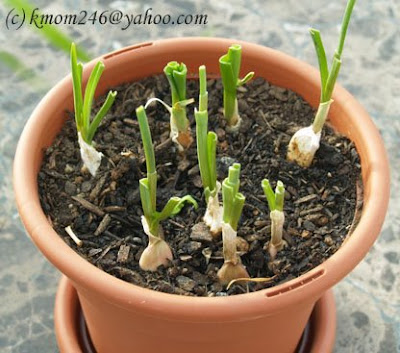
Garlic ShootsProcrastination means that I have a few "not doing so well" garlic cloves. None of them are actually rotting or moldy, but they certainly are not in their prime. But, can't let anything go to waste, so, like in 2007 (the photo above), I will plant the cloves in a pot. I'll water them well, let them stay outside for a few weeks (so they think Winter has come), and then bring them inside and put in a sunny window sill (so they think Spring has arrived). Keep moist but not soggy and within a few weeks, garlic shoots should rise up. When they get to be 4 or 5 or 6 inches tall, cut a few inches off the top and use like garlic chives. They'll continue to grow for a few months until their storage of food in the clove is used up. Then it is into the compost pile with them. I don't like green onions, so I use these whenever I need green onions.
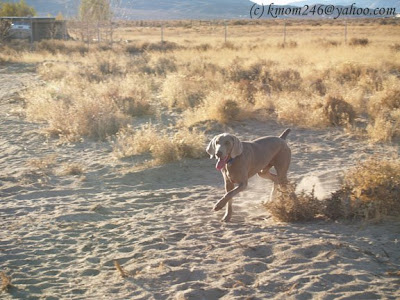
Jake 2006This is a picture of Jake from October 2006. He's running over what would eventually become the western fence line of my garden. He's buried out in the back, now, within site of the garden.
Speaking of burials, this flower grows in the shady areas of Laurelwood Cemetery in Savannah, Ga. Don't know what it is, but it was blooming in July last year when I visited.
Farm Fresh Egg Yolk
Here you can see the "chalaza" from one of my eggs. Usually when you break an egg, the chalaza will break near the yolk and recoil and stick to the membrane still in the shell. You can see a good drawing of the parts of an egg at 4-H Virtual Farm (http://www.sites.ext.vt.edu/virtualfarm/poultry/poultry_eggparts.html) I have been trying to take a clear photo of the germinal disc of an egg - it is the very tiny spot that can tell you if an egg is fertile or not. My yolks all seem to land "spot side down", so I haven't captured one of my own, yet. The website mentioned above has a link to a photo of a germinal disc.

Three things I have noticed about my "cage free" chickens are that 1) the yolks are much deeper yellow than store bought eggs - sometimes they are nearly orange, 2) the yolks are strong - you really need to pre-beat them in a cup if you want to break them up - or really stab them with the spatula in the pan (wow, even I can make easy-over eggs with these eggs!), and 3) the shells are much, much harder. This is pretty interesting to me, since they chickies are not "free range" or "organic". They get scientifically, commercially formulated (drug-free) chicken feed, corn-based (drug-free) chicken scratch, oatmeal, scrap veggies, and oyster shell (if they want it). Threw some scratch out in my fallow garden beds this afternoon, so the chickens plowed it up rather nicely while hunting down their goodies. Life is good.
... except, probably, for the 3 chickens that are being culled today. The two Easter Egger roosters (Fancy Pants and The Princess) and EE no. 38 are being relocated to a family in CA who will be, most likely, eating them. They are in a dog crate awaiting transportation (yes, they have access to water). The whole rest of the flock is already much happier with just the two Maran roos.
The two EE roosters were getting meaner and meaner, both to me and the hens. They would corner a hen and be pretty rough on her. The hens would stress out and scatter whenever the two EEs came near... but the two Maran roosters are gentle and the hens will actually go up to them and "present" themselves. I guess we'll be having Maran and Maran crossbreed babies in the early summer! (The Marans, as a species, seem to be more interested in eating than fighting or being mean... gentleness is a good trait to breed into a flock.)
Brown EE no. 38 started pulling feathers and picking on all the hens a few weeks ago. We tried to cure her of her bad habbits, but when she started picking so badly that she was drawing blood and nearly killed one of her flock-mates, we knew she had to go. Don't want her teaching the others how to do such things... the SLW that got all beat up is in "hospital confinement" in a dog crate in the hen house. That way she can rest up without the roosters or others bothering her, but talk to the other chickens and still be part of the flock. Don't know if she will make it or not. She is bare chicken skin on several spots on her back and looks pretty pecked at and bruised.

Wednesday, December 3, 2008

Oh, no, more Photoshop

Maran Egg by kmom246@yahoo.comThe only thing exciting is the egg hunt and egg counts. Today there were a total of 9. 5 tan from the Silver Laced Wyandottes, 3 dark brown from the Marans and a weird olive colored egg that could have been an odd one from either a Maran or an Easter Egger.
Summer 2008 garlic by kmom246@yahoo.comUsed a bunch of this in some wonderful home made vegetable soup. The other ingredients were store bought, but still, nothing like fresh, hot soup on a cold winter day! The maroonish colored garlic have deep, golden brown cloves with a nice, spicy taste. The taste mellows with cooking, though, so I think my daughter could have tripled (or more) the amount of garlic in the soup! (Ok, so what if I think you can never have enough garlic!)Summer 2008 garlic by kmom246@yahoo.comYes, these are all made from actual digital photos of my 2008 garlic harvest. I'm so desperate for Spring and Summer that I have resorted to "photoshopping" my harvest!This is a still life that I took a few years ago. The lighting wasn't very good and it just didn't quite make it as a photograph. But I think it turned out OK as a photoshopped picture.